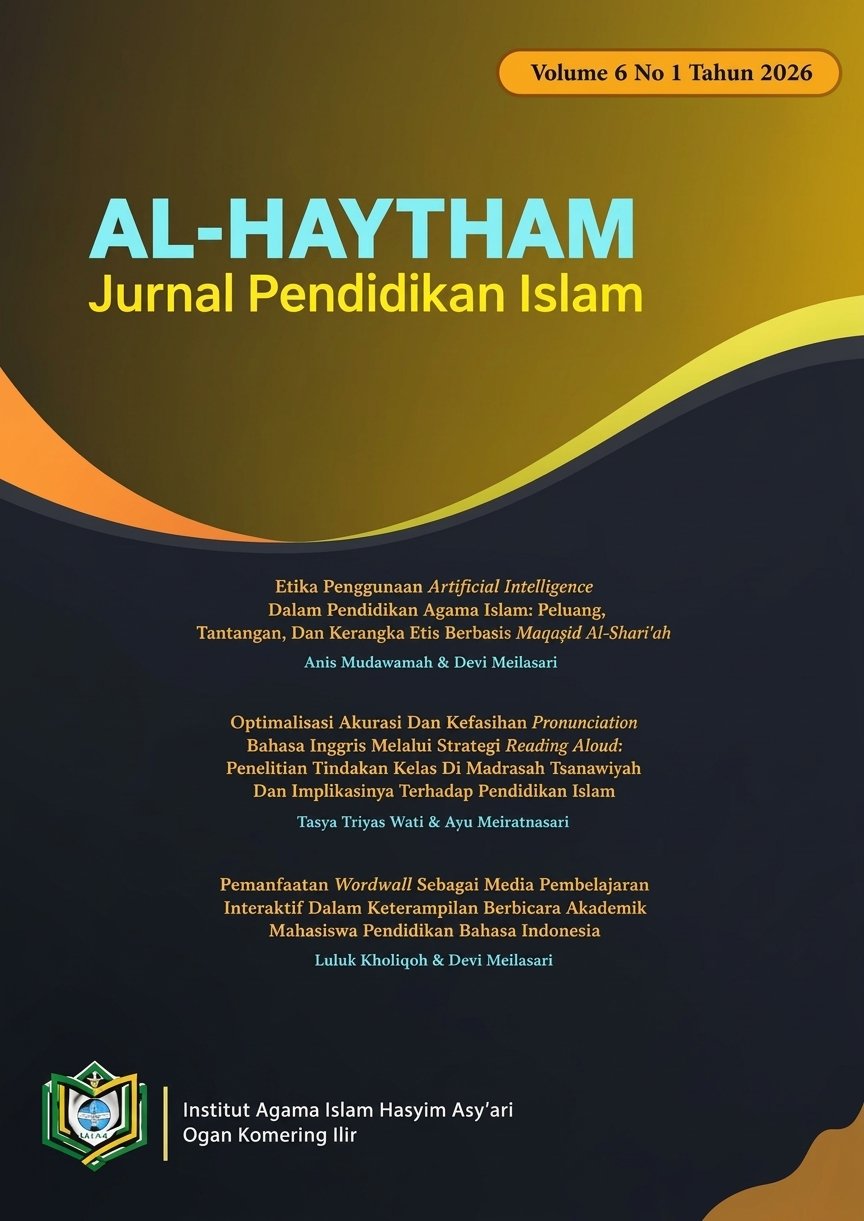
OPTIMALISASI AKURASI DAN KEFASIHAN PRONUNCIATION BAHASA INGGRIS MELALUI STRATEGI READING ALOUD: PENELITIAN TINDAKAN KELAS DI MADRASAH TSANAWIYAH DAN IMPLIKASINYA TERHADAP PENDIDIKAN ISLAM
Keywords:
Reading Aloud, Pronunciation, Penelitian Tindakan Kelas, Madrasah Tsanawiyah, Pendidikan Islam, FasohahAbstract
Penguasaan pengucapan (pronunciation) bahasa Inggris merupakan fondasi utama dalam membangun kompetensi komunikasi lisan yang efektif, namun sering kali mengalami hambatan pada pembelajar di lingkungan Madrasah Tsanawiyah pedesaan akibat keterbatasan paparan auditori autentik, kecemasan berbahasa, dan dominasi metode pengajaran berorientasi tata bahasa. Penelitian ini bertujuan untuk: (1) menganalisis implementasi strategi Reading Aloud dalam pembelajaran bahasa Inggris untuk meningkatkan kemampuan pronunciation siswa kelas IX MTs Darussalam Tugumulyo; (2) mengukur sejauh mana strategi Reading Aloud dapat meningkatkan akurasi dan kefasihan pelafalan siswa; serta (3) mengintegrasikan nilai-nilai Pendidikan Islam dalam proses pembelajaran lisan. Penelitian ini menggunakan desain Penelitian Tindakan Kelas (PTK) model Kemmis et al. (2014) yang dilaksanakan dalam dua siklus (masing-masing empat pertemuan) dari November hingga Desember 2025. Subjek penelitian terdiri dari 23 siswa kelas IX MTs Darussalam Tugumulyo dengan teknik total sampling. Data dikumpulkan melalui tes performa lisan (pre-test, post-test 1, post-test 2), lembar observasi, catatan lapangan, wawancara semi-terstruktur, dan kuesioner. Analisis data kuantitatif menggunakan statistik deskriptif, sedangkan data kualitatif dianalisis menggunakan teknik pengodean dan pemaknaan berjenjang dari Burns (2000). Hasil penelitian menunjukkan peningkatan signifikan pada rerata skor pronunciation siswa dari pre-test sebesar 5,7 (kategori sangat rendah) meningkat menjadi 11,1 pada post-test 1 (Siklus I), dan mencapai 14,4 pada post-test 2 (Siklus II) dari skor maksimal 16. Keempat indicator yaitu kejelasan pelafalan, akurasi bunyi, intonasi dan tekanan kata, serta kefasihan, mengalami peningkatan konsisten dari rerata 1,2–1,5 pada kondisi awal menjadi 3,6 pada akhir Siklus II. Secara kualitatif, strategi Reading Aloud terbukti menurunkan kecemasan berbahasa, menumbuhkan efikasi diri, dan menciptakan atmosfer belajar yang interaktif. Dalam perspektif Pendidikan Islam, strategi ini selaras dengan prinsip al-qira'ah al-jahriyyah, fasohah, dan itqan yang menekankan ketelitian pembacaan lisan, disiplin vokal, dan artikulasi pembacaan yang fasih.
References
Al Mawardi, M. R. (2023). Improving the teaching of pronunciation in a junior high school: Classroom action research. English Education Journal (EEJ), 14(2), 87–95.
Amrate, M., & Benabdallah, A. (2022). Computer-assisted pronunciation training: A systematic review. ReCALL Journal, 34(3), 280–295.
Awadh, F. M. A. M. (2024). Improving English pronunciation through phonetics and phonics instruction: A literature review. International Journal of Education and Literacy Studies, 12(3), 55–63.
Azra, A. (2019). Pendidikan Islam: Tradisi dan modernisasi di tengah tantangan milenium baru. Kencana.
Badawi, A. M. M., Alnour, N. T. B., Alamin, M. H. A., & Sanhori, S. B. (2020). The role of reading aloud strategy on improving reading and pronunciation for EFL pupils at private basic schools: Teachers' perspectives. LLT Journal: A Journal on Language and Language Teaching, 23(1), 1–15.
Brown, H. D. (2004). Language assessment: Principles and classroom practices. Pearson Education.
Brown, H. D. (2007). Teaching by principles: An interactive approach to language pedagogy (3rd ed.). Pearson Education.
Burns, A. (2000). Doing action research in English language teaching: A guide for practitioners. Routledge Taylor & Francis Group.
Celce-Murcia, M., Brinton, D. M., & Goodwin, J. M. (1996). Teaching pronunciation: A reference for teachers of English to speakers of other languages. Cambridge University Press.
Celce-Murcia, M., Brinton, D. M., & Goodwin, J. M. (2010). Teaching pronunciation: A course book and reference guide (2nd ed.). Cambridge University Press.
Dja'far, V. H. (2024). Improving English pronunciation skills through AI-based speech recognition. International Journal of Emerging Technologies in Learning (iJET), 19(2), 45–58.
El Husna, I., & Sari, S. Y. (2023). Correlation between reading aloud and pronunciation skills. Journal of English Language Teaching, 12(2), 110–120.
Escobar Rosero, S. E. (2023). Reading-aloud technique and English pronunciation [Tesis magister, Universidad Técnica de Ambato, Ekuador].
Fathurrochman, I., & Rofi'i, A. (2021). Internalization of Islamic education values in language pedagogy: A study in Indonesian madrasahs. Tadris: Jurnal Keguruan dan Ilmu Tarbiyah, 6(1), 99–110.
Fraser, H. (2000). Coordinating improvements in pronunciation teaching for adult learners of English as a second language. Department of Education, Training and Youth Affairs, Australia.
Ghosn, I. K. (2002). Four good reasons to use literature in the primary school ELT. ELT Journal, 56(2), 172–179.
Harmer, J. (2007). The practice of English language teaching (4th ed.). Pearson Longman.
Hasbrouck, J., & Tindal, G. (2006). Oral reading fluency norms: A valuable assessment tool for reading teachers. The Reading Teacher, 59(7), 636–644.
Kemmis, S., McTaggart, R., & Nixon, R. (2014). The action research planner: Doing critical participatory action research. Springer.
Koda, K., & Ruan, Y. (2021). Reading processes in second language learners. Language Teaching, 54(2), 123–145.
Krashen, S. D. (1982). Principles and practice in second language acquisition. Pergamon Press.
Lo, M.-F. (2024). Facilitating EFL pronunciation and reading instruction through Immersive Reader and Reading Progress. Korea TESOL Journal, 20(1), 77–96.
Masduqi, H. (2010). Improving English pronunciation through reading aloud technique. Jurnal Pendidikan Bahasa dan Sastra, 11(1), 45–52.
Mejía Sánchez, E. J., & Proaño López, G. L. (2023). The impact of audio-readings on the pronunciation of past tense verbs in EFL students. Polo del Conocimiento, 8(2), 1–15.
Metruk, R. (2024). Mobile-assisted language learning and pronunciation instruction: A systematic review. Educational Technology Research and Development, 72(1), 215–235.
Morley, J. (1991). The pronunciation component in teaching English to speakers of other languages. TESOL Quarterly, 25(3), 481–520.
Mukminin, A., Masbirorotni, A., & Habibi, A. (2020). English language teaching in Islamic schools: Contextual challenges and teachers' pedagogical practices. Journal of Islamic Education and Learning, 8(2), 120–138.
Nation, I. S. P. (2009). Teaching ESL/EFL listening and speaking. Routledge.
Nirwana, T., Jufri, J., & Refnaldi, R. (2025). Systematic review: How the reading aloud strategy is still used in the last five years. Journal of English Language Pedagogy, 13(1), 15–28.
Nurcholish, A., & Rohman, M. (2022). Integration of Islamic values in English language teaching: A systematic literature review. IJIE: Indonesian Journal of Islamic Education, 6(1), 45–60.
Omar, A. (2016). Read-aloud technique to enhance pre-school children's vocabulary in a rural school in Malaysia. Southeast Asia Early Childhood Journal, 5, 17–27.
Putra, R. A. (2017). The effect of reading aloud strategy on students' pronunciation. English Education Journal, 8(2), 55–63.
Rahmawati, R., & Sari, D. P. (2022). Challenges in learning English pronunciation for Indonesian EFL learners. Journal of English Language Teaching and Linguistics, 7(1), 30–41.
Rasinski, T. V. (2003). The fluent reader: Oral reading strategies for building word recognition, fluency, and comprehension. Scholastic Inc.
Richards, J. C., & Renandya, W. A. (Eds.). (2002). Methodology in language teaching: An anthology of current practice. Cambridge University Press.
Septiani, R. (2020). Improving students' pronunciation skills through reading aloud strategy. Jurnal Pendidikan Bahasa Inggris, 8(1), 34–45.
Skinner, B. F. (1957). Verbal behavior. Appleton-Century-Crofts.
Subakir, S., & Hidayat, A. (2023). Tartil-based approach in foreign language pronunciation: Pedagogy in Islamic secondary schools. Al-Ta'lim Journal, 30(2), 145–158.
Syafitri, Y. D. T., Budiarti, V., & Derin, T. (2023). Reviewing the effectiveness of reading aloud technique in EFL context: Is it better than silent reading? Oral: Journal of Language and Linguistics, 9(1), 1–10.
Wulandari, S. (2021). Enhancing students' pronunciation through reading aloud strategy. Jurnal Education and Language, 5(2), 101–112.
Yusuf, M., & Azizah, S. (2021). Reading aloud strategy to enhance pronunciation in EFL classroom: A classroom action research. English Education: Journal of English Teaching and Research, 6(2), 89–98.
Zamil, N. A. M. (2010). Reading aloud practices by ESL teachers [Tesis magister, Universiti Teknologi MARA, Malaysia].
Downloads
Published
Issue
Section
License
Copyright (c) 2026 Ayu Meiratnasari, Tasya Triyas Wati

This work is licensed under a Creative Commons Attribution-ShareAlike 4.0 International License.