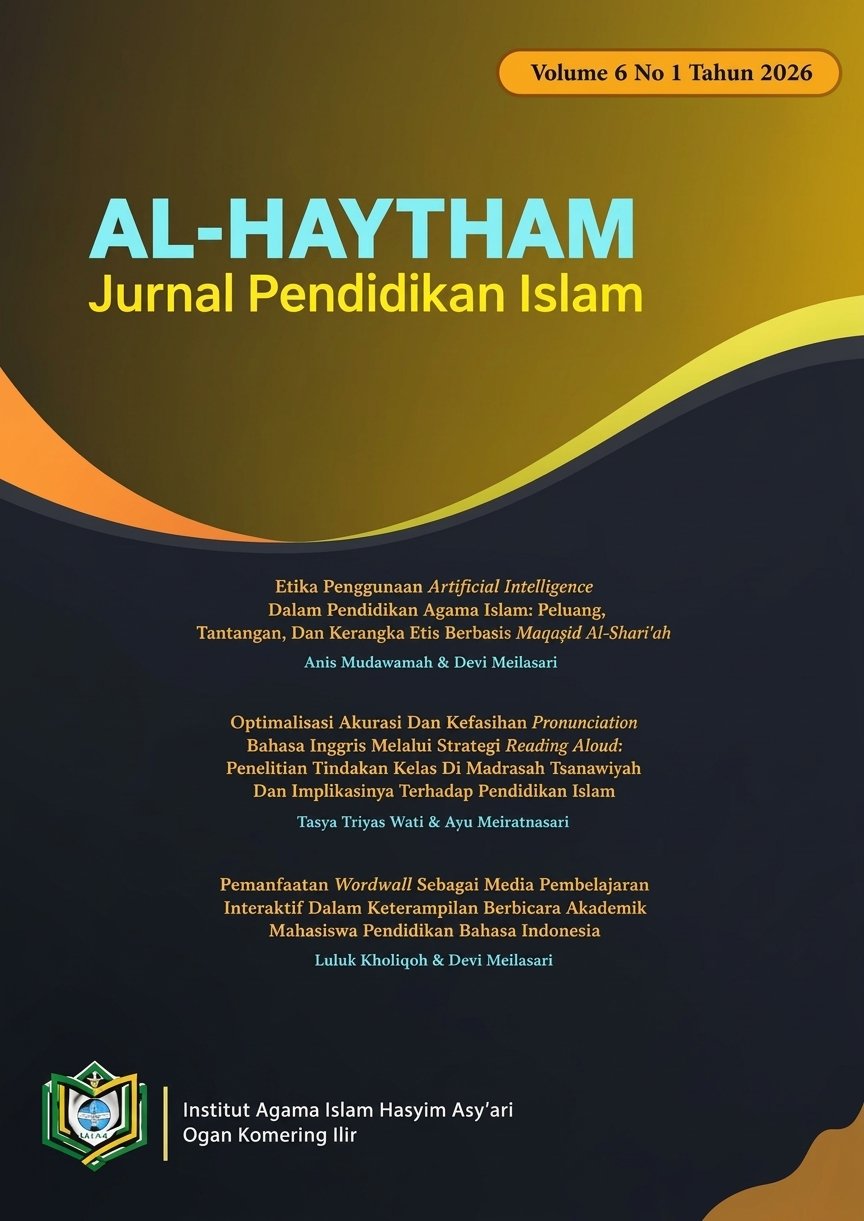
ETIKA PENGGUNAAN ARTIFICIAL INTELLIGENCE DALAM PERSPEKTIF PENDIDIKAN AGAMA ISLAM: PELUANG, TANTANGAN, DAN KERANGKA ETIS BERBASIS MAQASID AL-SHARI’AH
Keywords:
Artificial Intelligence; Pendidikan Agama Islam; etika AI; maqāṣid al-sharī‘ah; literasi AI; integritas akademikAbstract
Perkembangan Artificial Intelligence (AI), khususnya generative AI, telah mengubah cara informasi diproduksi, diakses, dan digunakan dalam pendidikan. Dalam Pendidikan Agama Islam (PAI), perubahan tersebut menghadirkan peluang pedagogis berupa personalisasi pembelajaran, perluasan sumber belajar, dukungan penyusunan materi dan asesmen, serta efisiensi kerja pendidik. Pada saat yang sama, karakter PAI yang berorientasi pada pembentukan iman, akhlak, tanggung jawab, dan kematangan spiritual menjadikan persoalan etika, otoritas pengetahuan, integritas akademik, privasi, bias algoritmik, dan ketergantungan teknologi semakin penting. Penelitian ini bertujuan menganalisis peluang dan tantangan penggunaan AI dalam PAI serta merumuskan kerangka etis berbasis nilai-nilai Islam. Penelitian menggunakan pendekatan kualitatif dengan desain studi kepustakaan. Literatur ilmiah dan dokumen kebijakan terbitan 2016–2026 ditelusuri secara purposif dan dianalisis melalui reduksi, kategorisasi tematik, komparasi, dan sintesis interpretatif. Hasil penelitian menunjukkan empat temuan utama: AI berpotensi memperkuat akses dan personalisasi pembelajaran; penggunaan tanpa pengawasan dapat mengganggu validitas pengetahuan, berpikir kritis, dan integritas akademik; AI tidak dapat menggantikan fungsi guru sebagai murabbi dan teladan; dan etika penggunaan AI perlu dibangun melalui integrasi maq??id al-shar?‘ah, shidq, tabayyun, amanah, ‘adl, taw?zun, ihsan, serta tanggung jawab manusia. Artikel ini menawarkan prinsip human-in-the-loop untuk PAI, yaitu AI ditempatkan sebagai was?lah, sedangkan otoritas pedagogis, verifikasi keagamaan, dan tanggung jawab moral tetap berada pada manusia.
References
Amaly, A. M., Muhammad, G., Erihadiana, M., & Zaqiah, Q. Y. (2021). Kecakapan guru Pendidikan Agama Islam dalam mengoptimalkan pembelajaran berbasis teknologi. Jurnal Pendidikan Agama Islam Al-Thariqah, 6(1), 88–104. https://doi.org/10.25299/al-thariqah.2021.vol6(1).6712
Akgun, S., & Greenhow, C. (2022). Artificial intelligence in education: Addressing ethical challenges in K-12 settings. AI and Ethics, 2, 431–440. https://doi.org/10.1007/s43681-021-00096-7
Chen, L., Chen, P., & Lin, Z. (2020). Artificial intelligence in education: A review. IEEE Access, 8, 75264–75278. https://doi.org/10.1109/ACCESS.2020.2988510
Cotton, D. R. E., Cotton, P. A., & Shipway, J. R. (2024). Chatting and cheating: Ensuring academic integrity in the era of ChatGPT. Innovations in Education and Teaching International, 61(2), 228–239. https://doi.org/10.1080/14703297.2023.2190148
Eke, D. O. (2023). ChatGPT and the rise of generative AI: Threat to academic integrity? Journal of Responsible Technology, 13, 100060. https://doi.org/10.1016/j.jrt.2023.100060
Elmahjub, E. (2023). Artificial intelligence (AI) in Islamic ethics: Towards pluralist ethical benchmarking for AI. Philosophy & Technology, 36, 73. https://doi.org/10.1007/s13347-023-00668-x
Fauziyati, W. R. (2023). Dampak penggunaan Artificial Intelligence (AI) dalam pembelajaran Pendidikan Agama Islam. Jurnal Review Pendidikan dan Pengajaran, 6(4), 2180–2187. https://doi.org/10.31004/jrpp.v6i4.21623
Hicks, M. T., Humphries, J., & Slater, J. (2024). ChatGPT is bullshit. Ethics and Information Technology, 26, 38. https://doi.org/10.1007/s10676-024-09775-5
Hoeruman, M. R., Kuswanto, R. T., Subha, R., Dewi, A. F., & Khoirunnisa, K. (2024). Transformasi Pendidikan Agama Islam menuju era digital dan Artificial Intelligence. Muaddib: Islamic Education Journal, 7(2), 72–83. https://doi.org/10.19109/MUADDIB.V7I2.28200
Holmes, W. (2022). State of the art and practice in AI in education. European Journal of Education, 57(4), 542–570. https://doi.org/10.1111/ejed.12533
Holmes, W., Porayska-Pomsta, K., Holstein, K., Sutherland, E., Baker, T., Buckingham Shum, S., Santos, O. C., Rodrigo, M. T., Cukurova, M., Bittencourt, I. I., & Koedinger, K. R. (2022). Ethics of AI in education: Towards a community-wide framework. International Journal of Artificial Intelligence in Education, 32, 504–526. https://doi.org/10.1007/s40593-021-00239-1
Kasneci, E., Sessler, K., Küchemann, S., Bannert, M., Dementieva, D., Fischer, F., Gasser, U., Groh, G., Günnemann, S., Hüllermeier, E., Krusche, S., Kutyniok, G., Michaeli, T., Nerdel, C., Pfeiffer, F., Poquet, O., Sailer, M., Schmidt, A., Seidel, T., Stadler, M., & Kasneci, G. (2023). ChatGPT for good? On opportunities and challenges of large language models for education. Learning and Individual Differences, 103, 102274. https://doi.org/10.1016/j.lindif.2023.102274
Khan, N., & Saunderson, S. (2024). Generative artificial intelligence in education: A narrative literature review. World Journal on Educational Technology: Current Issues, 16(2). https://doi.org/10.18844/wjet.v16i2.9217
Lo, C. K. (2023). What is the impact of ChatGPT on education? A rapid review of the literature. Education Sciences, 13(4), 410. https://doi.org/10.3390/educsci13040410
Miao, F., & Holmes, W. (2023). Guidance for generative AI in education and research. UNESCO. https://unesdoc.unesco.org/ark:/48223/pf0000386693
Mouta, A., Pinto-Llorente, A. M., & Torrecilla-Sánchez, E. M. (2024). Uncovering blind spots in education ethics: Insights from a systematic literature review on artificial intelligence in education. International Journal of Artificial Intelligence in Education, 34, 1166–1205. https://doi.org/10.1007/s40593-023-00384-9
Ng, D. T. K., Leung, J. K. L., Chu, K. W. S., & Qiao, M. S. (2021). AI literacy: Definition, teaching, evaluation and ethical issues. Proceedings of the Association for Information Science and Technology, 58(1), 504–509. https://doi.org/10.1002/pra2.487
OECD. (2021). AI and the future of skills, Volume 1: Capabilities and assessments. OECD Publishing. https://doi.org/10.1787/5ee71f34-en
Rahman, M. R. N., & Afandi, N. K. (2024). Islamic Education students’ perceptions: A phenomenological study on the ethical of using Artificial Intelligence (AI) in learning. J-PAI: Jurnal Pendidikan Agama Islam, 11(1), 45–57. https://doi.org/10.18860/jpai.v11i1.27932
Sarinda, F., Martina, M., Noviani, D., & Hilmin, H. (2023). Pendidikan Agama Islam berbasis teknologi (AI) Artificial Intelligence. Jurnal Kajian Penelitian Pendidikan dan Kebudayaan, 1(4), 103–111. https://doi.org/10.59031/jkppk.v1i4.268
Sullivan, M., Kelly, A., & McLaughlan, P. (2023). ChatGPT in higher education: Considerations for academic integrity and student learning. Journal of Applied Learning & Teaching, 6(1). https://doi.org/10.37074/jalt.2023.6.1.17
Tlili, A., Shehata, B., Adarkwah, M. A., Bozkurt, A., Hickey, D. T., Huang, R., & Agyemang, B. (2023). What if the devil is my guardian angel: ChatGPT as a case study of using chatbots in education. Smart Learning Environments, 10, 15. https://doi.org/10.1186/s40561-023-00237-x
U.S. Department of Education, Office of Educational Technology. (2023). Artificial intelligence and the future of teaching and learning: Insights and recommendations. U.S. Department of Education.
UNESCO. (2021). AI and education: Guidance for policy-makers. UNESCO.
Yan, L., Sha, L., Zhao, L., Li, Y., Martinez-Maldonado, R., Chen, G., Li, X., Jin, Y., & Gašević, D. (2024). Practical and ethical challenges of large language models in education: A systematic scoping review. British Journal of Educational Technology, 55, 90–112. https://doi.org/10.1111/bjet.13370
Yusuf, A., Pervin, N., Román-González, M., & Noor, N. M. (2024). Generative AI in education and research: A systematic mapping review. Review of Education, 12, e3489. https://doi.org/10.1002/rev3.3489
Zawacki-Richter, O., Marín, V. I., Bond, M., & Gouverneur, F. (2019). Systematic review of research on artificial intelligence applications in higher education – where are the educators? International Journal of Educational Technology in Higher Education, 16, 39. https://doi.org/10.1186/s41239-019-0171-0
Berendt, B., Littlejohn, A., & Blakemore, M. (2020). AI in education: Learner choice and fundamental rights. Learning, Media and Technology, 45(3), 312–327.
Ashok, M., Madan, R., Joha, A., & Sivarajah, U. (2022). Ethical framework for Artificial Intelligence and Digital technologies. International Journal of Information Management, 62, 102433. https://doi.org/10.1016/j.ijinfomgt.2021.102433
Floridi, L., & Chiriatti, M. (2020). GPT-3: Its nature, scope, limits, and consequences. Minds and Machines, 30, 681–694. https://doi.org/10.1007/s11023-020-09548-1
Fengchun, M., & Holmes, W. (2023). Guidance for generative AI in education and research. UNESCO. ISBN 978-92-3-100612-8
Nguyen, T. N., & Truong, H. T. (2025). Trends and emerging themes in the effects of generative artificial intelligence in education: A systematic review. Eurasia Journal of Mathematics, Science and Technology Education.
Fathorrozy, Syarifah, N., Anam, K., & Qomariyah, N. (2026). Kerangka etis Artificial Intelligence dalam pendidikan Islam: Mengintegrasikan Maqasid Syariah di era pembelajaran digital. re-JIEM (Research Journal of Islamic Education Management), 371–384. https://doi.org/10.19105/re-jiem.vi.24289
Downloads
Published
Issue
Section
License
Copyright (c) 2026 Devi Meilasari, Anis Mudawamah

This work is licensed under a Creative Commons Attribution-ShareAlike 4.0 International License.